Tuesday, November 7, 2017

Sailing to Sutton Harbour

As much fun as we were having in Falmouth, it was time to head out.  We had made plans to keep Terrapin in Plymouth for the winter, based on suggestions from Jenny and TJ on Rocket Science who we met in La Coruna, Spain.  Plymouth sounded like a great place to spend a cold and rainy six months and the beginning of those six months had arrived.

We picked a nice Saturday afternoon to sail the 45 miles east to Plymouth with the wind about 130 degrees behind us - and nice following seas.  We also left at first light in order to time the tides in our favor.  

Sutton Harbor where we were headed has a lock system (think Panama Canal) so that the water levels remain consistent and the low tide that would typically dry out the harbor, does not drop the water levels below a predetermined height.  The locks also help to keep swell from storms out of the harbour.  However, in order to do this, the lock is only opened for three hours before and after high tide (aka "free flow").  It is possible to "lock-in" at other times as necessary, through a series of steps that essentially let you in one door, wait while it closes and then the other door opens to let you out.  

As we motored through the lock and into Sutton Harbor - our slip was straight in front of us.  We secured Terrapin and headed out to check out the town of Plymouth.


Leaving Falmouth at dawn's early light
Sailing past the Royal Citadel into Sutton Harbor
The outside lock at Sutton Harbor
Into our protected marina with the lock behind us
Our home for the winter
The Sutton Harbor lock under the white bridge - next to the fish statue.  Also, you can see the tide level on the rock wall - this is low tide so the lock is closed).  Lastly, the Mayflower steps are on the bottom left where the people are standing.  This is where the Mayflower left from about 397 years ago.  More about that later.

Saturday, November 4, 2017

Travel Money

While we travel, we have to be prepared for weather, language, culture and...money.  Since January of 2017, we have needed to use eight different types of currency:  USD, Euros, EC, Cuban Convertible Pesos (CUC), Cuban Pesos (CUP), Canadian dollars, Irish pounds and British pounds.  Sounds simple but if you think about converting and (typically) losing money in the conversion, and finding an ATM or bank to get cash, it is not that easy or cost efficient.  Also, when it comes to Northern Ireland and Cuba, the process is really complicated and you don't know the details until you are in the midst of a transaction.

In the Caribbean:
French islands use Euros
Dutch islands take guilders or USD (so we just use USD)
Most British islands use EC (Eastern Caribbean); some use USD but will charge more; except the BVI, which uses USD.
Dominica and independent islands generally also take EC.
Cuba uses the CUC and the CUP.  Foreigners should only use the CUC and cubans use the CUP.  However, Cubans realized they can get better goods if they use the foreigner's CUCs so they started trading using that currency.  Then foreigners realized they can get things cheaper with the CUP, so they started using that currency and things soon became all mixed up.  Generally, a foreigner should expect to use the CUC except at local markets and very small paladars but will probably end up with CUPs and have to get rid of everything before they leave the island since they can't use it anywhere else on earth.

Canada:
Canada wants to get along with everyone - you can use Canadian Dollars or US but will get more for your money if you use CAD.

Spain:
Euros.  Pretty simple.

Republic of Ireland:
Euros.  Again - let's not complicate this.

Northern Ireland:
Pound Sterling - you can use Bank of Ulster, Bank of Scotland or Bank of England money - they will take any of it, but....keep reading about what happens when you get to England.

England:
Pound Sterling - oldest currency in the world still in production and the fourth most traded.  A person can only use Bank of England money in England.  So if you have anything left over from Northern Ireland that is not Bank of England, it is worthless and you should have used it while you were in Northern Ireland but before you went back to Republic of Ireland.  (Northern Ireland kind of gets treated like the red-headed stepchild by England - I think if I were them I might want to leave the kingdom too)

Whew...Keeping it all straight and also sorted in its own pocket is a challenge.

Well, off to do laundry and figure out my coins.

A geographic representation of some of the money we've used.  *As a note, CUPs (for local Cubans) are distinguished because they have people on their money versus CUCs (for foreigners to Cuba) which have monuments.  This is Camilo Cienfuegos, other denominations have Che Guevara or Fidel Catro.
A handful of everything


Wednesday, November 1, 2017

More of Falmouth and Beyond

We continued to explore Falmouth and the surrounding areas for a couple weeks.  One of our absolute favorite things to do was the National Maritime Museum.  With the purchase of one ticket for £12, a person would have entry for an entire year.  We took full advantage, pacing ourselves and saving plenty to do over the course of a couple of weeks.  Every day that rained (remember, this is the UK, so that's just about every other day), we would explore another section and learn a little bit more.   

The main exhibits at the museum are currently the art of tattooing and the story of Captain Bligh, famous for the mutiny aboard The Bounty in the South Pacific.  William Bligh was a unique character who had drama follow him everywhere he went and there is definitely more to his story than just that mutiny episode. His ancestral home was in Cornwall which makes learning about him here in Falmouth pretty significant.  

When it wasn't raining, we would take the dinghy up the Fal river (thus the name Falmouth, which lies at the mouth of the river) to Mylor or we would go across Carrick Roads over to St Mawes.  We also took the bus up to Truro which is the county seat of Cornwall.  As usual, the experience is not necessarily the destination, but more about the journey.  We explored the area on a daily basis, whether it was beaches or villages or museums - Falmouth was entertaining and fun, much more than expected.  We were sad to leave but look forward to going back next spring.  

There were a couple feet under the dinghy when we went ashore but you guessed it, low tide leaves the dinghy high and dry.  Good thing we can carry it back to the water.
The gaff-rigged schooner, Eda Frandsen, in front of St Mawes castle
Dinghy-ing around castles
Bummer
Watch your food...finders keepers
Up close with St Mawes castle
Guess what time it is....lowwwww tide
All bundled up, ready for a dinghy ride
Upstairs on the double decker
"Take care on stairs"
Yep, even in the UK this is a common sentiment.
Truro Cathedral
Beautiful flying buttresses
In the maritime museum workshop, they are recreating a lifeboat from the Titanic.  The model they are working from is on the table
This is the radio that was onboard Suhaili, which belonged to Sir Robin Knox-Johnston (knighted after his voyage).  Knox-Johnston was the first person to sail solo, nonstop around the world (1969).  Wow - times have changed - I couldn't imagine having a radio of this size aboard Terrapin
They have a tower in the museum where you can see tidal levels through the windows.  See the high tide mark on the wall  (top right) and the mid-tide halfway down.  The placards on the wall below "Mid Tide" are about 6' up from the floor.
The only place we ever want to be in a life raft is in an exhibit in a museum.

Sunday, October 29, 2017

The Other English

We thought we'd have to wait until we were in Norway or Sweden, maybe France to be entrenched in a culture that spoke another language. 

Don't ye know, Ireland has two official languages:  Irish (Gaelic) and English.  Sometimes, people use a combination of the two.

Here are a few of our Gaelic favorites that we've heard:
Cobh = Pronounced Cove; A town close to Crosshaven
Youghl = Pronounced Yawl; A town close to Crosshaven
Slan = Bye or Cheers
Slan abhaile = Pronounced slan awallya; Safe home or Have a safe trip
Go Mall = slow down
Tog bog e = please go slow
Baile Átha Cliath = Dublin
Lough = Pronounced lock; A lake
Bruscar = Trash can

Even when the Irish are speaking English sometimes it can be hard to know completely what is being said.  Quite often, there are idioms that are being expressed that will take us a minute to understand and respond.  A couple that we heard were:

> If the sun were out, we'd all be flyin' = Could you imagine if the sun was shining?
> How ye keeping'? = How are you?


Even when we arrived in the UK, there was an adjustment period where we might not understand what the other person was saying, and worse, they might not understand us and don't you know we were all speaking English.

The most common translations for us:
You alright? = Would you like to order something in the bar?
Half Twelve = 12:30
Granary or bleached? = Which type of bread would you like - wheat or white?
Car Park = Parking Lot
Lorry Park = Truck parking (o'carse)
Squibbly/scribbly = Signature, as in "Can I get your scribbly on this receipt please?"
Chips = French fries
Crisps = potato chips
Bonnet = hood of the car
Boot = trunk of the car
You’re having me on = you’re kidding with me

Baxter and I even find ourselves using a couple of these now and again.  It is fun to fully embrace the culture, even if it's technically the same language you thought you knew.


Thursday, October 26, 2017

Falmouth, U.K.

We had no expectations for Falmouth, outside of the historical significance of sailors who have adventured through these waters for hundreds of years.  Well, as it turns out, it is every bit as awesome as it was centuries ago.

We started exploring by just walking up and down the streets, talking to locals and reading guide books.  The first pub we ventured into, 5 Degrees West, we thought we might be able to sit on the patio with Kala, as in Ireland, but it was rainy and we weren't sure we were in the mood to duck under the umbrella when it started to pour but we soon learned that not only was Kala welcome on the patio, but she could come inside (o'carse ye can) but they had a bag of treats ready for her too.  High points for Falmouth!!  It turns out Falmouth is cool for people and also very extremely doggie friendly, which makes the people's lives easier.

Now that we were on the mainland, we also needed to get a few things in order.  Our US phones were older (iPhone 5s) and we were not in the mood to upgrade a US number and have to pay international rates for the next year, so we just cancelled our US plans.  We replaced the iPhones with a circa 1990 Nokia flip phone with a UK sim card and saved money each month.  Anything that needed to be done smart phone-ish, we could do with our iPads and a wifi connection - now that we were near land, we should be able to get wifi fairly easily.

It was also time to learn how to food shop in England.  Every country has a different layout to their grocery stores and there are items in one place that you can't get in another, so we toured around understanding what is and isn't available in the UK.  We also learned that Cornwall (Falmouth's county) is proud, like Texas kind-of proud, of everything Cornish.  So we enjoyed the vibes and looked forward to sinking more into the culture.
Nice morning walk for Kala overlooking Falmouth
Doggie's are allowed - inside!
Furry Friends Welcome!!
It's really all we need to make voice calls
Main Street in Falmouth
Everything Cornish...very Cornwall proud
This is just a really cool building that was converted into flats (apartments) with great views of the harbour
This is the dinghy dock with the bridge to the marina - this is low tide.....you can use the dinghy heights (about 1.5 ft off the water or the building on the top left for perspective).  The tide is usually about 4-5 meters
This is high tide - compare to pic above to see the tidal height differences
Dry dock in Falmouth.  You can see at the stern of the boat the boat is on hard ground.  It looked like they were doing repairs on the thrusters but you can't see that in this picture.
Some days it is cold and rainy.  The frost collected on Kala's whiskers but she was still smiling and happy to go for a run.
A sunny day on a morning walk
I thought this was pretty neat and something good for the US to adopt.  Charities open up stores (similar to Goodwill) and resell donations in order to raise money.  They are all over the place and include all kinds of different charities.

Monday, October 23, 2017

Sailing to Mainland England

The weather and tides worked out the next morning to carry us out of the harbor in St Mary's and then we planned it so we would have favorable current most of the day towards Falmouth.

As expected, there was quite a bit of traffic as we crossed the English Channel towards Falmouth.  We had great wind to sail all the way to the mouth of the harbour.  The sun was shining and it was pretty fun to see mainland England and realize how many sailors in history, including Vikings, Romans, Spanish Armadas, Explorers and legendary sailors who have seen the exact same headlands and cliffs, and had the same tides and currents and navigated the same rocks and overfalls.  The realization that our hard work in prepping Terrapin and crossing the Atlantic to reach this point on the planet was a good feeling - the kind you get when you feel like you have accomplished something special and you'd like to relish in the moment.

So, we managed the cargo traffic around Falmouth, found another green mooring buoy - similar to St Mary's - and secured Terrapin.  Based on all the salty boats around us, this was going to be a great town to explore!

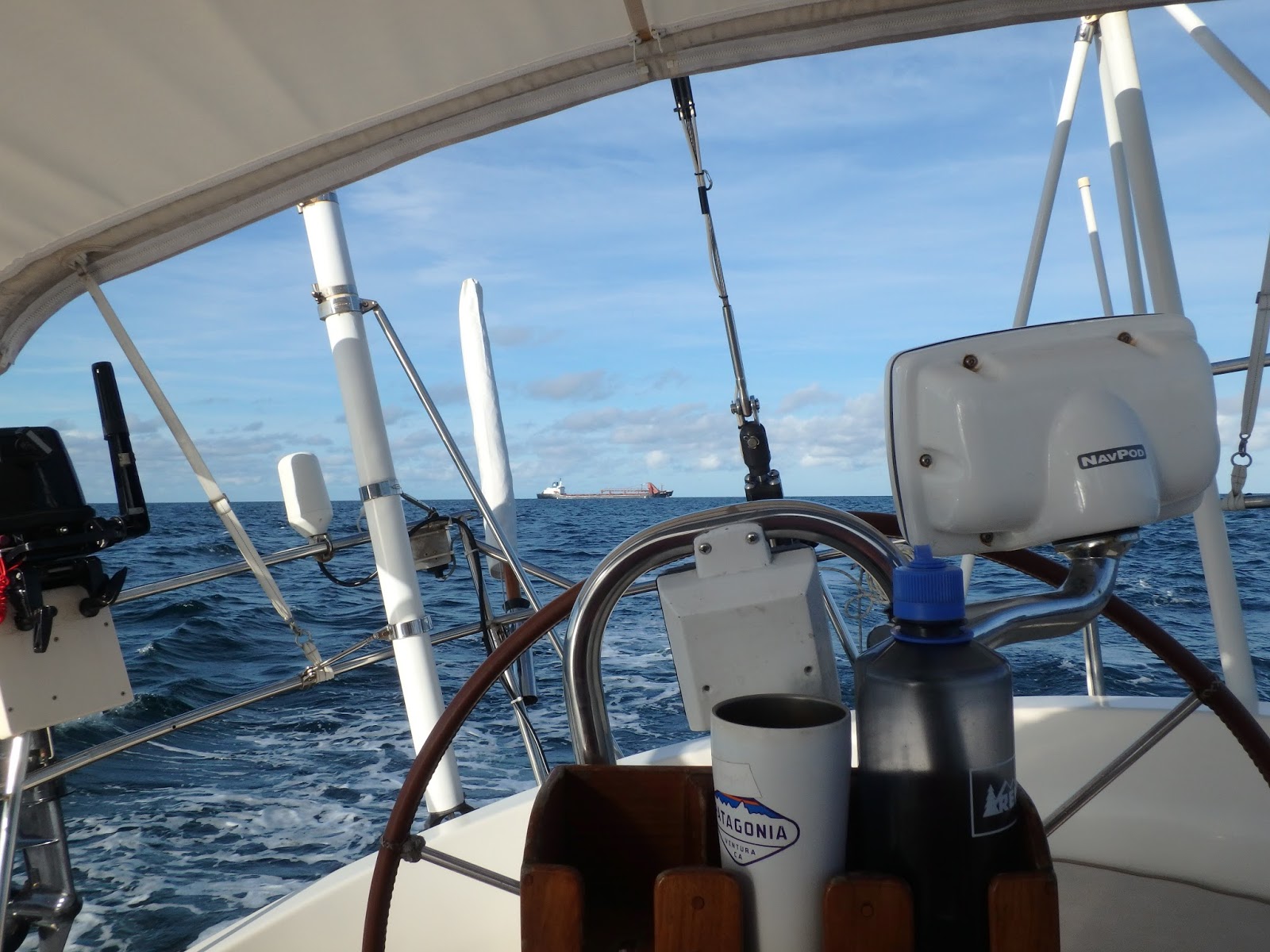
An awesome broad reach through the English Channel with cargo ships less than a mile away
Land Ho!  First views of mainland England!
As we sailed into Falmouth Harbor, we had to mind the cargos.
Pendennis Castle on the west side of Carrick Roads into Falmouth
Terrapin in Falmouth
Baxter checking the mooring lines while Kala supervises

Friday, October 20, 2017

Isles of Scilly

We woke up the next morning to a beautiful day.  It was quite unusual for this time of year in the Isles of Scilly.  It was warm, the sun was shining and we were secure on our mooring.

We took Kala to the beach for a swim then for a long hike and explored St Mary's.  Since it was Sunday, quite a few shops were closed but there was a pub, a bakery and wifi available.  A charming little island which seems very busy in the summer but since we were approaching the fall, it was quieter than usual, much to our delight.

It was interesting to switch gears from Ireland to the UK.  Money was in Pounds, not Euros, the beers were different (except Guiness - everyone has Guiness on tap - everywhere), the accents were different and the vocabulary changed, a wee bit.  We were super excited to experience the UK.
Terrapin has arrived in the United Kingdom
This is my dinghy.  Have you seen my dinghy?  I love my dinghy - a -lot!!
The village of St Mary's
Such a variety of boats in the anchorage.  Terrapin in the back (center of photo with tallest mast)
All's well when there's a beach
Beautiful ketch careening on low tide.
Let's go this way!
Enjoying the sunshine!
Salty ol' pub
RNLI Lifeboat - I imagine the Celtic Sea can be nasty and these are the guys who come rescue boats - all volunteers
"Take me to my boat - faster, please"
Cool jellies washed ashore